Getting Started: Wang (2006) Cross‑Wind Integrated Footprint
This notebook shows how to use the wang_footprint.py module from the fluxfootprints library to compute the Wang et al. (2006) cross‑wind‑integrated footprint, and (optionally) reconstruct a 2‑D footprint by assuming a Gaussian lateral spread.
What you’ll do
Import the Wang (2006) functions from your local
srccheckout.Compute the 1‑D cross‑wind integrated footprint (f_y(x)).
(Optional) Reconstruct a 2‑D footprint (f(x, y)) and visualize it.
Extract practical distances (e.g., x for 50%, 80%, 90% cumulative contribution).
CBL validity: The Wang (2006) parameterisation targets convective daytime conditions and requires negative Monin‑Obukhov length
L < 0. Use with caution outside the published range.
[1]:
# --- Setup & Imports ----------------------------------------------------------
import os, sys, math, numpy as np

# Use your local project layout: notebook in e.g. `notebooks/`, package in `src/`
# The user requested: use sys.path.append("../../src")
sys.path.append("../../src")

# Now import from the package/module
from fluxfootprints.wang_footprint import wang2006_fy, reconstruct_gaussian_2d
print("Imports OK. Using fluxfootprints from:", [p for p in sys.path if p.endswith("/src")])
Imports OK. Using fluxfootprints from: ['../../src']
[2]:
# --- Quick environment check --------------------------------------------------
import numpy as np, matplotlib
print("NumPy:", np.__version__)
print("Matplotlib:", matplotlib.__version__)

# Optional: show docstring summaries
print("\nwang2006_fy:", wang2006_fy.__doc__.splitlines()[0])
print("reconstruct_gaussian_2d:", reconstruct_gaussian_2d.__doc__.splitlines()[0])
NumPy: 2.2.2
Matplotlib: 3.10.0

wang2006_fy: Cross‑wind integrated footprint ``f_y(x)`` (m⁻¹).
reconstruct_gaussian_2d: Reconstruct a 2‑D footprint ``f(x,y)`` from a 1‑D ``f_y(x)``.
1) Provide inputs
You need:
zm— measurement height above ground (m)h— convective boundary‑layer height (m)L— Monin‑Obukhov length (negative for convective)Optional:
U(mean wind speed, m s⁻¹) andsigma_v(lateral velocity std, m s⁻¹) to define the lateral spread for the 2‑D reconstruction.
Below, the cell will try to discover any example CSV/JSON in a nearby examples/ or data/ folder. If none is found, it will fall back to a synthetic convective case that produces a reasonable footprint.
[3]:
# --- Try to auto‑discover example inputs -------------------------------------
from pathlib import Path
import json, csv

def try_load_examples():
    candidates = [
        Path("../examples"), Path("../../examples"),
        Path("./examples"), Path("../data"), Path("../../data")
    ]
    # Simple heuristics: look for small CSV/JSON that might contain zm,h,L,U,sigma_v
    for base in candidates:
        if not base.exists():
            continue
        for ext in ("*.csv", "*.json"):
            for f in base.glob(ext):
                try:
                    if f.suffix.lower() == ".json":
                        with open(f, "r", encoding="utf-8") as fp:
                            data = json.load(fp)
                        keys = {k.lower() for k in data.keys()}
                        if {"zm","h","l"}.issubset(keys):
                            return dict(zm=float(data["zm"]), h=float(data["h"]), L=float(data["l"]),
                                        U=float(data.get("U", 3.5)), sigma_v=float(data.get("sigma_v", 0.6))), f
                    else:  # CSV
                        with open(f, "r", encoding="utf-8") as fp:
                            reader = csv.DictReader(fp)
                            for row in reader:
                                keys = {k.lower() for k in row.keys()}
                                if {"zm","h","l"}.issubset(keys):
                                    return dict(zm=float(row["zm"]), h=float(row["h"]), L=float(row["L"]),
                                                U=float(row.get("U", 3.5)), sigma_v=float(row.get("sigma_v", 0.6))), f
                except Exception:
                    # Not an expected format; keep scanning
                    pass
    return None, None

params, src_file = try_load_examples()

if params is None:
    # Fallback: synthetic daytime convective case
    params = dict(
        zm=3.0,     # m
        h=800.0,    # m
        L=-120.0,   # m  (must be negative for convective)
        U=3.5,      # m/s
        sigma_v=0.6 # m/s
    )
    print("No example file found. Using synthetic parameters:", params)
else:
    print(f"Loaded example parameters from {src_file}: {params}")

zm, h, L, U, sigma_v = params["zm"], params["h"], params["L"], params["U"], params["sigma_v"]
assert L < 0.0, "Wang (2006) requires convective conditions (L < 0)."
No example file found. Using synthetic parameters: {'zm': 3.0, 'h': 800.0, 'L': -120.0, 'U': 3.5, 'sigma_v': 0.6}
2) Compute the 1‑D cross‑wind‑integrated footprint (f_y(x))
We’ll evaluate (f_y(x)) along a stream‑wise distance vector x (positive upwind).
[5]:
import numpy as np

# Stream‑wise grid (m); extend far enough upwind for the tail to decay
x = np.linspace(0.0, 6000.0, 601)  # 10 m spacing
fy = wang2006_fy(x, zm=zm, h=h, L=L)

# Basic checks
dx = x[1] - x[0]
mass = np.trapezoid(fy, x)
print(f"Integral ∫ f_y dx ≈ {mass:.6f} (should be ~1.0)")
print(f"Max f_y at x ≈ {x[np.argmax(fy)]:.1f} m")
Integral ∫ f_y dx ≈ 1.000000 (should be ~1.0)
Max f_y at x ≈ 10.0 m
[6]:
# --- Plot f_y(x) --------------------------------------------------------------
import matplotlib.pyplot as plt

plt.figure()
plt.plot(x, fy, lw=2)
plt.xlabel("Upwind distance x (m)")
plt.ylabel("Cross-wind integrated footprint f_y(x) (m$^{-1}$)")
plt.title("Wang (2006) CWI footprint")
plt.grid(True)
plt.show()
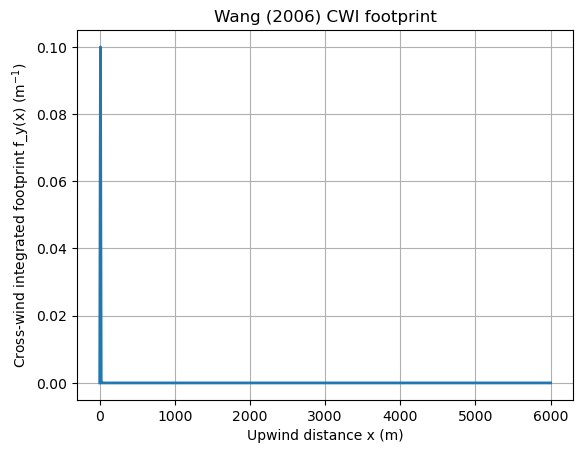
3) Practical distances by cumulative contribution
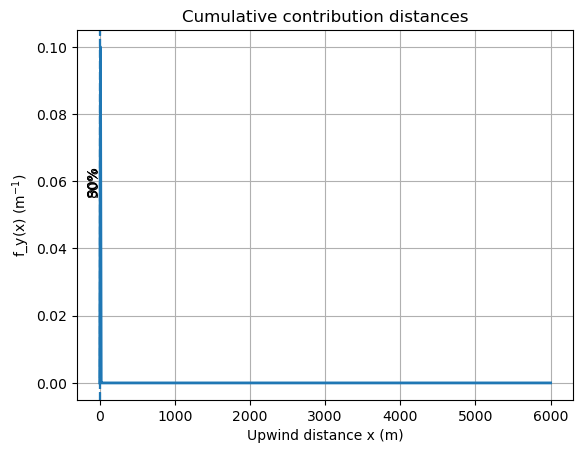
You can extract distances that capture a chosen fraction of the source area (e.g., 50%, 80%, 90%) by integrating (f_y(x)).
[7]:
cum = np.cumsum(fy) * (x[1] - x[0])

def x_at_fraction(frac):
    idx = np.searchsorted(cum, frac)
    return float(x[min(idx, len(x)-1)])

x50, x80, x90 = x_at_fraction(0.50), x_at_fraction(0.80), x_at_fraction(0.90)
print(f"x_50% ≈ {x50:.1f} m,  x_80% ≈ {x80:.1f} m,  x_90% ≈ {x90:.1f} m")
x_50% ≈ 10.0 m, x_80% ≈ 10.0 m, x_90% ≈ 10.0 m
[8]:
# Re-plot with markers for 50/80/90%
import matplotlib.pyplot as plt

plt.figure()
plt.plot(x, fy, lw=2)
for xv, label in [(x50, "50%"), (x80, "80%"), (x90, "90%")]:
    plt.axvline(x=xv, ls="--")
    plt.text(xv, max(fy)*0.6, label, rotation=90, va="center", ha="right")
plt.xlabel("Upwind distance x (m)")
plt.ylabel("f_y(x) (m$^{-1}$)")
plt.title("Cumulative contribution distances")
plt.grid(True)
plt.show()
4) (Optional) Reconstruct a 2‑D footprint (f(x, y))
Use a Gaussian lateral distribution with width (\sigma_y(x)). By default, (\sigma_y = \alpha `x) with (:nbsphinx-math:alpha :nbsphinx-math:approx 0.3`). If you have turbulence stats, you can pass sigma_v and U to use (\sigma_y = (\sigma_v/U),x).
[9]:
# Compute the 2-D reconstruction using turbulence-based sigma_y
X, Y, F = reconstruct_gaussian_2d(x, fy, sigma_v=sigma_v, U=U, ny=241)

# Sanity check: F integrates to ~1 over the domain
dx = x[1] - x[0]
dy = Y[1,0] - Y[0,0]
mass2d = np.sum(F * dx * dy)
print(f"Double integral ∬ F dx dy ≈ {mass2d:.6f}")
Double integral ∬ F dx dy ≈ 1.000000
[10]:
# --- Visualize the 2-D footprint ---------------------------------------------
import matplotlib.pyplot as plt
extent = [x.min(), x.max(), Y.min(), Y.max()]

plt.figure()
plt.imshow(F.T, origin="lower", aspect="auto", extent=extent)
plt.colorbar(label="f(x,y) (m$^{-2}$)")
plt.xlabel("Upwind distance x (m)")
plt.ylabel("Cross-wind distance y (m)")
plt.title("2-D Footprint (Gaussian reconstruction)")
plt.show()
5) Save results
These examples show how to export the computed arrays to common formats.
[11]:
# Save 1-D footprint to CSV
import pandas as pd
one_d = pd.DataFrame({"x_m": x, "f_y_per_m": fy, "cum_frac": np.cumsum(fy)*(x[1]-x[0])})
one_d.to_csv("wang2006_fy_example.csv", index=False)
print("Wrote: wang2006_fy_example.csv")

# Save 2-D footprint as NumPy .npz
np.savez_compressed("wang2006_2d_example.npz", X=X, Y=Y, F=F)
print("Wrote: wang2006_2d_example.npz")
Wrote: wang2006_fy_example.csv
Wrote: wang2006_2d_example.npz
Troubleshooting
``ValueError: L must be negative`` — The Wang (2006) scheme is for convective conditions; ensure your
Lis negative.``x must be non‑negative`` — The model expects positive upwind distances (start at
x=0and move upstream).If your
∫ f_y dxor∬ F dx dyis not close to 1, ensure yourxrange is sufficiently long so the tail has decayed.If you don’t have
sigma_vandU, omit them; the model will use a simple (\sigma_y = \alpha `x) with ``alpha=0.3` by default.
Next steps
Combine the 2‑D footprint with gridded surface properties (land cover, LAI, NDVI) to compute weighted footprints.
Convert the 2‑D grid to geospatial rasters (GeoTIFF) or vector contours (GeoPackage) using your GIS stack.
Batch‑process multiple time periods and summarise daily or monthly contributions using your preferred data pipeline.