Getting Started: Lagrangian Stochastic (LS) Footprint Model
This notebook shows how to use the ``ls_footprint_model.py`` module to compute a simple 2‑D flux footprint from eddy‑covariance tower data. It uses the attached example configuration (US-UTE.ini) and data file referenced therein.
1) Setup
This section adjusts sys.path so you can import from your local source tree, then imports the LS model. If you’ve installed the package, the first import will also work.
[2]:
# --- Standard library
import os, sys, math, pathlib, warnings

# --- Third‑party
import numpy as np
import pandas as pd
import matplotlib.pyplot as plt

sys.path.append("../../src")
from fluxfootprints.ls_footprint_model import LSFootprintConfig, BackwardLSModel

plt.rcParams["figure.dpi"] = 120
warnings.filterwarnings("ignore")
print("Imports ready.")
Imports ready.
2) Load site configuration and data
We read US-UTE.ini to discover the time column, wind variables, and file names. Then we load the CSV it references and make a minimal set of variables needed by the LS model.
[3]:
import configparser
from pathlib import Path

# Point to the example INI and CSV (adjust paths as needed)
ini_path = Path("US-UTE.ini")
if not ini_path.exists():
    ini_path = Path("./input_data/US-UTE.ini")  # fallback for this shared environment

cfg = configparser.ConfigParser(interpolation=None)
cfg.read(ini_path)

# Pull the essentials
date_col = cfg.get("DATA", "datestring_col")
date_fmt = cfg.get("METADATA", "date_parser")
skiprows = cfg.getint("METADATA", "skiprows", fallback=0)
missing_val = cfg.getfloat("METADATA", "missing_data_value", fallback=-9999.0)

# Columns for wind speed and direction
ws_col = cfg.get("DATA", "wind_spd_col", fallback="WS")
wd_col = cfg.get("DATA", "wind_dir_col", fallback="WD")

# Resolve the climate/data CSV next to the INI, or in the same folder
csv_rel = cfg.get("METADATA", "climate_file_path")
csv_path = ini_path.parent / csv_rel
if not csv_path.exists():
    csv_path = Path("/mnt/data") / csv_rel  # fallback

# Load data
parse = lambda s: pd.to_datetime(s, format=date_fmt, errors="coerce")
df = pd.read_csv(csv_path, skiprows=skiprows)
df[date_col] = df[date_col].apply(parse)
df = df.dropna(subset=[date_col]).set_index(date_col).sort_index()

# Basic cleaning for common missing value flags
df = df.replace({missing_val: np.nan, -9999: np.nan, -9999.0: np.nan})

print(f"Loaded {len(df):,} rows from:", csv_path)
df.head()
Loaded 3,283 rows from: input_data/US-UTE_HH_202406241430_202409251400.csv
[3]:
| datetime_start | TIMESTAMP_END | CO2 | CO2_SIGMA | H2O | H2O_SIGMA | FC | FC_SSITC_TEST | LE | LE_SSITC_TEST | ... | TA_1_2_1 | RH_1_2_1 | T_DP_1_2_1 | TA_1_3_1 | RH_1_3_1 | T_DP_1_3_1 | TA_1_4_1 | PBLH_F | TS_2_1_1 | SWC_2_1_1 | |
|---|---|---|---|---|---|---|---|---|---|---|---|---|---|---|---|---|---|---|---|---|---|
| TIMESTAMP_START | |||||||||||||||||||||
| 2024-06-24 14:30:00 | 2024-06-24 14:30:00 | 202406241500 | 427.0199 | 0.628133 | 17.26862 | 1.019290 | 0.069210 | NaN | 156.40850 | NaN | ... | 29.95141 | 33.26877 | 12.052600 | 30.32464 | 33.45364 | 12.46181 | 30.06976 | 1665.4670 | 25.72815 | 22.44161 |
| 2024-06-24 15:00:00 | 2024-06-24 15:00:00 | 202406241530 | 425.9499 | 1.019297 | 15.18936 | 0.703052 | 0.285446 | NaN | 138.30920 | NaN | ... | 30.02516 | 29.22197 | 10.155240 | 30.35956 | 29.77183 | 10.72635 | 30.13765 | 1765.9350 | 25.52736 | 22.41975 |
| 2024-06-24 15:30:00 | 2024-06-24 15:30:00 | 202406241600 | 426.4163 | 1.965228 | 14.87533 | 0.808026 | 1.081928 | NaN | 154.11530 | NaN | ... | 30.24634 | 28.28498 | 9.838229 | 30.69433 | 28.63222 | 10.41335 | 30.40344 | 1495.7350 | 25.12511 | 22.32785 |
| 2024-06-24 16:00:00 | 2024-06-24 16:00:00 | 202406241630 | 426.0534 | 2.665907 | 15.61140 | 1.002919 | 0.519664 | NaN | 135.56180 | NaN | ... | 30.75179 | 28.75255 | 10.538220 | 31.14621 | 29.16225 | 11.09066 | 30.90061 | 1491.0620 | 24.63557 | 22.18172 |
| 2024-06-24 16:30:00 | 2024-06-24 16:30:00 | 202406241700 | 427.8476 | 1.102921 | 15.21034 | 0.703084 | 1.147608 | NaN | 95.06287 | NaN | ... | 29.16274 | 30.77158 | 10.165810 | 29.57434 | 30.96792 | 10.63069 | 29.30510 | 341.9711 | 24.14865 | 22.03216 |
5 rows × 61 columns
3) Choose a time slice and prepare LS model inputs
The LS model needs:
zm(receptor height, m)ustar(friction velocity, m s⁻¹)L(Monin–Obukhov length, m) — not used in this minimal implementation but kept for extensionh(boundary‑layer height, m)wind_dir_deg(meteorological from direction, degrees)surface roughness
z0and a numerical grid/domain
If your dataset has a USTAR column, we use that. Otherwise we estimate (u_*) from wind speed by the neutral log‑law (requires assumptions for zm and z0).
[4]:
KAPPA = 0.4

# Assumptions you can tune for your site
zm_default = 4.0   # receptor height [m]
z0_default = 0.1   # roughness length [m]
h_default  = 1000.0
L_default  = -50.0  # kept for API compatibility; not used in the core model

# Pick a representative timestamp with non‑missing wind + speed
needed = [wd_col]
if "USTAR" in df.columns:
    needed.append("USTAR")
else:
    needed.append(ws_col)

sub = df.dropna(subset=needed).copy()
if sub.empty:
    raise RuntimeError("No rows with required variables present. Check column names and missing values.")

row = sub.iloc[0]  # take the first valid row; feel free to select by date/time

# Derive ustar if needed
if "USTAR" in df.columns and pd.notna(row.get("USTAR")):
    ustar = float(row["USTAR"])
else:
    # Estimate u* with neutral log profile: u* = κ U / ln(zm / z0)
    U = float(row[ws_col])
    ustar = KAPPA * U / math.log(zm_default / z0_default)

wind_dir_deg = float(row[wd_col])
zm, z0, h, L = zm_default, z0_default, h_default, L_default

print(f"Selected time: {row.name}")
print(f"u* = {ustar:.3f} m s⁻1 | wind_dir = {wind_dir_deg:.1f}° | zm={zm} m, z0={z0} m, h={h} m")
Selected time: 2024-06-24 14:30:00
u* = 0.285 m s⁻1 | wind_dir = 83.8° | zm=4.0 m, z0=0.1 m, h=1000.0 m
4) Run the model
[5]:
cfg = LSFootprintConfig(
    zm=zm,
    ustar=ustar,
    L=L,
    h=h,
    wind_dir_deg=wind_dir_deg,
    z0=z0,
    n_particles=20_000,   # increase for smoother fields
    dt=0.25,
    t_max=600.0,
    domain=(2000.0, 2000.0),
    dx=20.0,
    dy=20.0,
    seed=42,              # reproducible runs
)
model = BackwardLSModel(cfg)
model.run()

x, y, F = model.footprint()
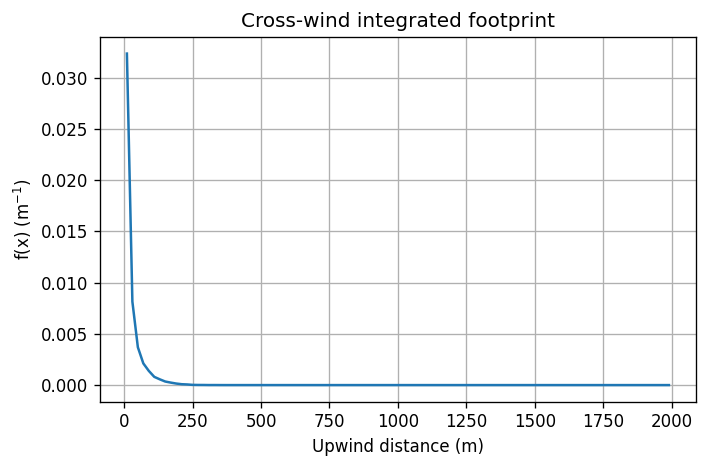
xx, fx = model.crosswind_integrated()

F.min(), F.max(), F.sum()
[5]:
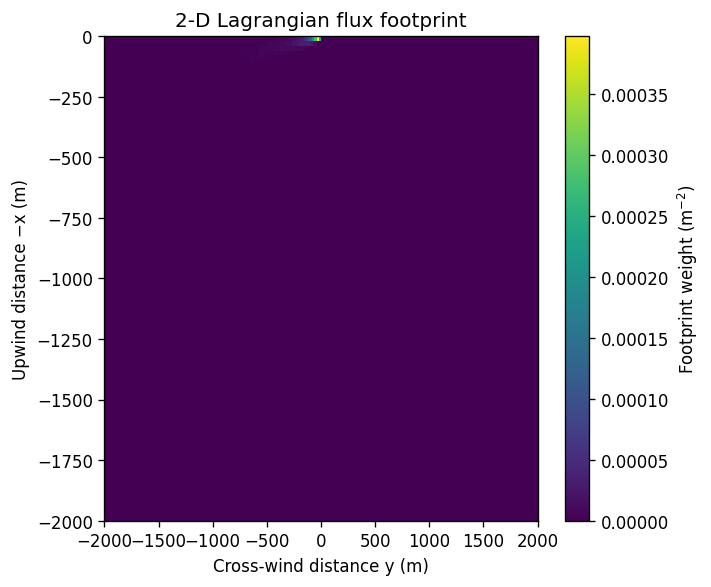
(np.float64(0.0), np.float64(0.00039797840676442895), np.float64(0.0025))
5) Visualize the footprint
[6]:
plt.figure(figsize=(6, 5))
plt.pcolormesh(y, x, F, shading="auto")
plt.colorbar(label="Footprint weight (m$^{-2}$)")
plt.xlabel("Cross‑wind distance y (m)")
plt.ylabel("Upwind distance −x (m)")
plt.title("2‑D Lagrangian flux footprint")
plt.tight_layout()
plt.show()

plt.figure(figsize=(6, 4))
plt.plot(-xx, fx)  # positive axis for downwind distance
plt.xlabel("Upwind distance (m)")
plt.ylabel("f(x) (m$^{-1}$)")
plt.title("Cross‑wind integrated footprint")
plt.grid(True)
plt.tight_layout()
plt.show()
6) Optional: 80% source area contour
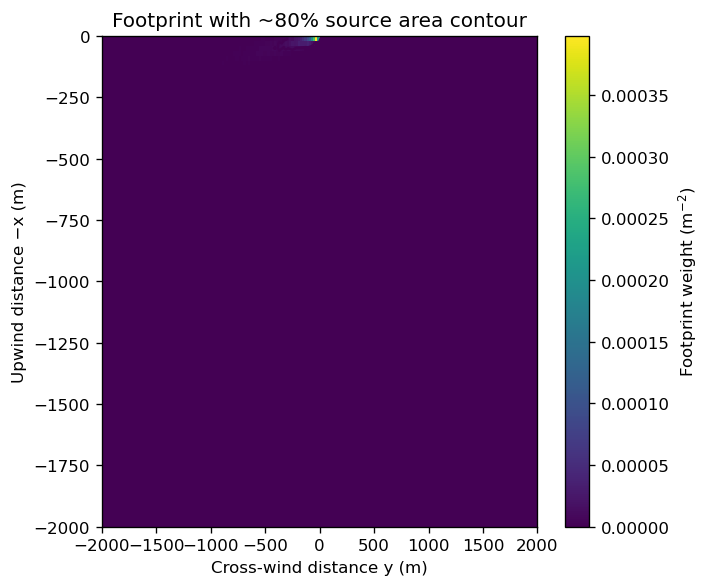
Below we compute a density threshold such that the integral of the footprint inside the contour is ~80% of the total. We then plot that as a single contour line.
[9]:
# Convert density (m^-2) to probability mass per cell
cell_mass = F * cfg.dx * cfg.dy
flat = cell_mass.ravel()
order = np.argsort(flat)[::-1]
csum = np.cumsum(flat[order])

# Find threshold where cumulative mass first exceeds 0.8
idx_thr = int(np.searchsorted(csum, 0.8))
thr_mass = flat[order][idx_thr]
thr_density = thr_mass / (cfg.dx * cfg.dy)

plt.figure(figsize=(6, 5))
plt.pcolormesh(y, x, F, shading="auto")
plt.colorbar(label="Footprint weight (m$^{-2}$)")
cc = plt.contour(y, x, F, levels=[thr_density])
plt.clabel(cc, fmt="80% area", inline=True, fontsize=8)
plt.xlabel("Cross‑wind distance y (m)")
plt.ylabel("Upwind distance −x (m)")
plt.title("Footprint with ~80% source area contour")
plt.tight_layout()
plt.show()
7) Save outputs (optional)
[ ]:
out_dir = Path("outputs")
out_dir.mkdir(exist_ok=True)

# Save grids
np.save(out_dir / "footprint_density.npy", F)
np.savetxt(out_dir / "footprint_density.csv", F, delimiter=",")
np.savetxt(out_dir / "x_centers_m.csv", x, delimiter=",")
np.savetxt(out_dir / "y_centers_m.csv", y, delimiter=",")

# Save figures
plt.figure(figsize=(6, 5))
plt.pcolormesh(y, x, F, shading="auto")
plt.colorbar(label="Footprint weight (m$^{-2}$)")
plt.xlabel("Cross‑wind distance y (m)")
plt.ylabel("Upwind distance −x (m)")
plt.title("2‑D LS Footprint")
plt.tight_layout()
plt.savefig(out_dir / "footprint_2d.png", dpi=200)
plt.close()

plt.figure(figsize=(6, 4))
plt.plot(-xx, fx)
plt.xlabel("Upwind distance (m)")
plt.ylabel("f(x) (m$^{-1}$)")
plt.title("Cross‑wind integrated footprint")
plt.grid(True)
plt.tight_layout()
plt.savefig(out_dir / "footprint_fx.png", dpi=200)
plt.close()

print("Saved outputs to:", out_dir.resolve())
8) Tips & next steps
Increase
n_particlesfor smoother fields (e.g., 50,000–200,000).Adjust
domain,dxanddyto control the spatial extent and resolution.If you have measured
USTAR, use it directly; otherwise, provide a better local estimate forz0and set your actualzm.The current
Lparameter is kept for future extensions (e.g., stability‑dependent turbulence); it is not used in the core update step here.For climatological footprints, repeat runs across many time steps and average the resulting
Ffields (watch memory and runtime).